In a moment, I'm going to email you my responses to your first assignment. I'm sending each of you a word document with in-text comments added. In terms of completing the assignment, both of you did just fine.
A writing comment I made to both of you is to try and include more specific examples in the future. These examples could take the form of names, facts and statistics, stories, images, and more. An example of what I mean is this: Instead of writing a general sentence like, "Charles had a long history of bad behavior," try something like this: "The first time Charles was arrested was at age nine when he was caught stealing the radio from his neighbor's Jeep. He followed that up with six more arrests before the age of 18. His first arrest for assault was for punching his ninth grade teacher in the nose after he failed an algebra test...." (This could keep going, of course, with more and more detail about Charles's criminal career. The point is that when you provide specific examples, three things happen: 1) you give your reader a much more precise version of events, 2) you explore your topic far more thoroughly, and 3) you generate much more material, making it easier to reach an assignment's required length.
In terms of the content-type questions I asked, there is no formal assignment, but I do expect you to read the questions, think about how you would answer them, and try to let this kind of thinking guide your assignments in the future.
Tuesday, January 28, 2014

Week 2 Assignment
Since we've been talking about physical versus non-physical violence, let's examine a seemingly non-violent act: throwing a pie in someone's face (as a form of protest or as a political statement).
Your assignment is as follows:
PS: If you look at some previous posts on this blog, you'll find links to some pieing videos.
Your assignment is as follows:
- Take a look around the internet and learn what you can about the topic. A Google search of "pie in the face" or "pieing" will get you started. The Wikipedia article on "pieing" has plenty of terms and examples you can use to continue your search. Also check out some pieing videos on YouTube. You'll find two major categories: pieings with the target's consent and pieings without. Think about both kinds, but our main focus is the latter.
- Write a short essay (no more than 500 words) reflecting on whether the act of pieing an unwilling victim constitutes an act of violence. If it does, how violent is it? Be sure to provide specific examples to support your conclusions.
PS: If you look at some previous posts on this blog, you'll find links to some pieing videos.
Class Plan
Hey guys. I wanted to talk more about a formal plan for the course tonight, but since class was cancelled, I'll give you a quick overview here, and then we'll discuss it more next week.
In general, I'll give you a small assignment each week (about the size of the week one assignment). This might involve personal reflection, responding to a text, or individual research. In general, you can interpret the instructions broadly: use my questions as a starting place, but don't feel like you have to stick to the topic 100%. If your interests take you in some other direction, feel free to follow them.
We'll also try to complete three larger assignments/projects.
If anything here presents a problem, please let me know.
In general, I'll give you a small assignment each week (about the size of the week one assignment). This might involve personal reflection, responding to a text, or individual research. In general, you can interpret the instructions broadly: use my questions as a starting place, but don't feel like you have to stick to the topic 100%. If your interests take you in some other direction, feel free to follow them.
We'll also try to complete three larger assignments/projects.
- Reading some longer text. (We need to select one very soon, so if you have any preferences, let me know. If I don't hear from you, I'm going to select something by the end of the week.)
- Watching and discussing a film. This may be related to the text in #1 or not.
- An individual research project. This will involve you educating yourself on a topic of your choice and writing an essay addressed to the rest of us, telling us what you found out. We will discuss your findings (informally) during our last meeting.
If anything here presents a problem, please let me know.
Monday, January 20, 2014
Assignment #1
Hi, Mary; hi,
Eric. I haven’t received a whole lot of ideas/preferences from either of you,
so I guess I will make more of those kinds of decisions. (This is perfectly
okay with me. I’m glad to provide a more structured plan for the course if
that’s what you prefer.) I will create a
syllabus and get it to you in the next couple of days. In the meantime, here is
the first assignment to get you started.
Assignment #1:
Reflection on Violence
During our first
meeting, we discussed various forms of violence. While physical violence seems
somewhat easy to define, other forms (i.e. emotional, deprivation,
intimidation, neglect, etc.) are more difficult. In a short (200-250 word)
essay, describe the essence of non-physical violence from your perspective. In
other words, what acts occur in the world that strike you, personally, as the
most violent?
Your essay
should include detailed examples of actual human behavior. You may use examples
from your own life, but you are not required to. Please don’t include anything
you aren’t comfortable discussing in our group.
It may help for
me to include here the definition of violence that I gave in class. This definition
might help you get started, but I hope you won’t feel limited by it:
Violence:
Intentional use of physical force or power, threatened or actual, against
oneself, another, or a community which either results or has a high likelihood
of resulting in injury, death, psychological harm, maldevelopment, or deprivation.
That is a
textbook definition. Your task now is to add your own interpretation by completing the sentence, “Violence
to me is _________________.”
Please email
your response to me by 8:00 A.M. on Monday January 27th. This will
give me time to respond prior to our in-person meeting on the 28th.
Let me know if
you have questions or problems.
Wednesday, January 15, 2014
Tentative Meeting Schedule
As we discussed last night, we will conduct this course as a partial independent study. Let's plan, tentatively, to meet on the following dates:
- January 14 (Already done.)
- January 28
- February 25 (We may choose to alter this one, depending on how the course is going.)
- March 25 (This is the term's last scheduled meeting, so we should probably stick to this date.)
Request for Feedback
Hello. As I said in class, I would like you to take a close look at some of this blog's earlier postings, and let me know what kinds of texts, topics, and assignments you would like to focus on this term. Remember, we want to make sure we approach the topic of Peacemaking from the following perspectives:
(See the post from 1/12 for a more detailed description of these perspectives.)
Also, keep in mind that we want to accomplish the following:
See if you can get back to me by, say, first thing Saturday morning. Once I've read your responses, I'll get back to you with some sort of more formal syllabus. Feel free to contact me if you have any questions.
- History
- Current events
- Fine arts
- Culture/Anthropology
- Sociology/Psychology
- Micro and macro
- Criminal Justice (This wasn't on the original list, but it's something that might interest us.)
(See the post from 1/12 for a more detailed description of these perspectives.)
Also, keep in mind that we want to accomplish the following:
- Read one major work (i.e., a novel, play, memoir, other nonfiction book).
- View one feature-length film (narrative, documentary, or other).
- Complete one larger research project.
See if you can get back to me by, say, first thing Saturday morning. Once I've read your responses, I'll get back to you with some sort of more formal syllabus. Feel free to contact me if you have any questions.
Sunday, January 12, 2014
SPRING 2014 BEGINS HERE
Hello. Welcome to Sociology 369: Peacemaking. This is the first post for Spring 2014.
As we have only two people enrolled in the course, we will conduct it as a partial independent study. As long as we meet the course's overall objectives, we have a good deal of flexibility in terms of texts and assignments. Your first assignment will be to carefully consider the previous material on this website and formulate an individual plan for the course. In short, what texts or kinds of texts would you like to examine? What kinds of assignments or projects would you like to complete? The texts and topics represented here reflect, mainly, the interests of previous classes. While we will surely recycle some of these items, we are not limited to what you see here.
As the description says, the course takes an interdisciplinary approach to peacemaking. While we will read some theory, we will also examine the topics of peacemaking, conflict, and social justice from a variety of perspectives. The list below includes some of the places from which we will approach the subject of peacemaking.
- Historical: We will look at various events in history and examine ways in which conflicts were and were not resolved. Past topics in this area have included the U.S. Civil Rights movement, the Holocaust, the Apartheid system, women's rights, the "tank man" of Tiananmen Square, and more.
- Current Events: News, the saying goes, is the first draft of history. Throughout the term, we should pay attention to the world around us and examine ways in which course concepts might apply.
- Artistic: How have issues of peace, war, conflict, and justice been portrayed by various artists during various periods? I will assign a few specific texts, but I hope you will suggest some others.
- Cultural/Anthropological: How does/has peacemaking and conflict resolution varied across different cultures and time periods?
- Sociological/Psychological: How does research in the social sciences inform our study? I will provide certain texts, and you will surely discover others.
- Micro/Macro: We will ensure that we examine the application of course concepts on both a global basis and an individual one. In other words, how can some of the principles we discuss be applied to society in general as well as to our own lives?
Tuesday, March 26, 2013
See this article from Salon Magazine and think about how the solutions proposed here might apply to the problems associated with the "poverty business" described in last week's Bill Moyers piece.
Saturday, March 23, 2013
Final Project Instructions
Just to reiterate the instructions announced in class, your final project should consist of three steps:
jf
- Choose a topic that truly interests you and learn all you can about it.
- Write a 2-3 page essay, that provides an overview of what you learned.
- Be prepared in Tuesday's class to summarize and answer questions about your research.
jf
Tuesday, March 19, 2013
Class, Wealth, and Poverty
Bill Moyers on the "Poverty Industry"

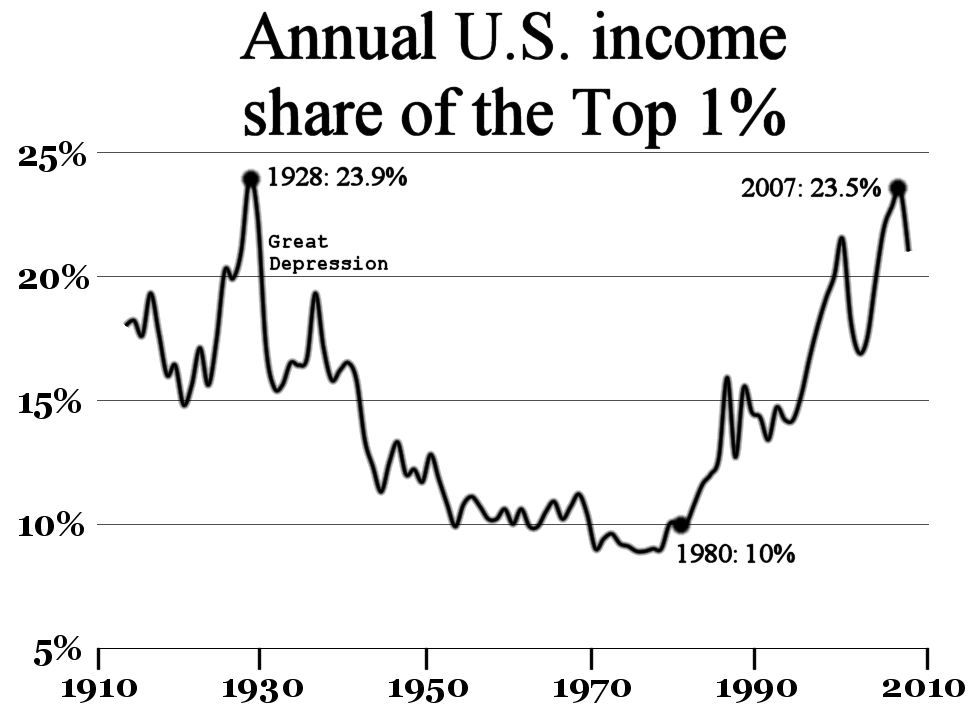


Activity:
You work in city government, and you are assigned to set the annual salaries of various city employees. You have $500,000 do distribute among the occupations listed below. Before assigning specific amounts to each occupation, consider the rationale for your decision. What are you basing each salary on? Difficulty of job? Contribution to society? Education and training? Prestige? Danger? Amount of responsibility? Traditional salary patterns? Overall fairness? Something else?
Once you have distributed the total amount among each occupation, write a short paragraph explaining how you reached your decision. Be prepared to defend your decision to angry employees who may feel like they are not getting their fair share.
Occupations:
Physician (GP)
Attorney
Garbage Collector
Second Grade Teacher
Plumber
Airport Shuttle Bus Driver
School Bus Driver
EMT
Farm Laborer
Banquet Server
Tuesday, March 12, 2013
Mother Night Quotations
Some lines from Mother Night to consider:
"Three people in all the world knew me for what I was--" I said. "And all the rest--" I shrugged.
"They knew you for what you were too," he said abruptly.
"That wasn't me," I said, startled by his sharpness.
“Be careful what you pretend to be, because you are what you pretend to be.”
“Future civilizations - better civilizations than this one - are going to judge all men by the extent to which they've been artists. You and I, if some future archaeologist finds our works miraculously preserved in some city dump, will be judged by the quality of our creations. Nothing else about us will matter.”
“When you're dead you're dead.”
“I have never seen a more sublime demonstration of the totalitarian mind, a mind which might be linked unto a system of gears where teeth have been filed off at random. Such snaggle-toothed thought machine, driven by a standard or even by a substandard libido, whirls with the jerky, noisy, gaudy pointlessness of a cuckoo clock in Hell.
The boss G-man concluded wrongly that there were no teeth on the gears in the mind of Jones. 'You're completely crazy,' he said.
Jones wasn't completely crazy. The dismaying thing about classic totalitarian mind is that any given gear, thought mutilated, will have at its circumference unbroken sequences of teeth that are immaculately maintained, that are exquisitely machined.
Hence the cuckoo clock in Hell - keeping perfect time for eight minutes and twenty-three seconds, jumping ahead fourteen minutes, keeping perfect time for six seconds, jumping ahead two seconds, keeping perfect time for two hours and one second, then jumping ahead a year.
The missing teeth, of course, are simple, obvious truths, truths available and comprehensible even to ten-year-olds, in most cases.
The wilful filling off a gear teeth, the wilful doing without certain obvious pieces of information -
That was how a household as contradictory as one composed of Jones, Father Keeley, Vice-Bundesfuehrer Krapptauer, and the Black Fuehrer could exist in relative harmony -
That was how my father-in-law could contain in one mind an indifference toward slave women and love fora a blue vase -
That was how Rudolf Hess, Commandant of Auschwitz, could alternate over the loudspeakers of Auschwitz great music and calls for corpse-carriers -
That was how Nazi Germany sense no important difference between civilization and hydrophobia -
That is the closest I can come to explaining the legions, the nations of lunatics I've seen in my time.”
“There are plenty of good reason for fighting," I said, "but no good reason ever to hate without reservation, to imagine that God Almighty Himself hates with you, too. Where's evil? It's that large part of every man that wants to hate without limit, that wants to hate with God on its side. It's that part of every man that finds all kinds of ugliness so attractive. "It's that part of an imbecile," I said, "that punishes and vilifies and makes war.”
“What can any one person do?' he said.
'Each person does a little something,' I said, 'and there you are.”
“I saw a huge steam roller,
It blotted out the sun.
The people all lay down, lay down;
They did not try to run.
My love and I, we looked amazed
Upon the gory mystery.
"Lie down, lie down!" the people cried.
"The great machine is history!"
My love and I, we ran away,
The engine did not find us.
We ran up to a mountain top,
Left history far behind us.
Perhaps we should have stayed and died,
But somehow we don't think so.
We went to see where history'd been,
And my, the dead did stink so. ”
“Dear Friends: As one who has experimented extensively with life in the home and community, using real people in true-life situations, I doubt that any playthings could prepare a child for one millionth of what is going to hit him in the teeth, ready or not.
...Let there be nothing harmonious about our children's playthings, lest they grow up expecting peace and order and be eaten alive."
“Since there is no one else to praise me, I will praise myself -- will say that I have never tampered with a single tooth in my thought machine, such as it is. There are teeth missing, God knows -- some I was born without, teeth that will never grow. And other teeth have been stripped by the clutchless shifts of history -- But never have I willfully destroyed a tooth on a gear of my thinking machine. Never have I said to myself, 'This fact I can do without.”
“[Hating America] would be as silly as loving it,” I said. “It’s impossible for me to get emotional about it, because real estate doesn’t interest me. It’s no doubt a great flaw in my personality, but I can’t think in terms of boundaries. Those imaginary lines are as unreal to me as elves and pixies. I can’t believe that they mark the end or the beginning of anything of real concern to the human soul. Virtues and vices, pleasures and pains cross boundaries at will.”
“So I am about to be a free man again, to wander where I please.
I find the prospect nauseating.
I think that tonight I will hand Howard W, Campbell, Jr., for crimes against himself.”
Tuesday, February 26, 2013
Truth and Reality
We've already examined "Popular Mechanics," and I've argued that the story takes its devastating power from the fact that it tells the truth about human experience. The story is difficult to read, not only because of its extreme content, but also because we recognize the "popular" (i.e.: widespread) nature of events like this one.
Tonight, we will look at other representations of human existence: works that depict the world in a less-than-completely-accurate way. (To be fair to the creators of these works, we should say that this type of accuracy is not their intention.) We will look at images and at least one film. For all of the works we examine, ask the following questions:


Tonight, we will look at other representations of human existence: works that depict the world in a less-than-completely-accurate way. (To be fair to the creators of these works, we should say that this type of accuracy is not their intention.) We will look at images and at least one film. For all of the works we examine, ask the following questions:
- How truthfully are characters, situations, and interactions represented?
- In what specific ways do these representations deviate from the reality you have experienced?
- In what specific ways do the works differ from each other?
- If the authors are not attempting to accurately represent reality, what are they attempting to do?
- Do you recognize any stereotypical patterns in the representations you see?
- What are the consequences of these representations? How common are they? How do they affect our cultural identity and behavior?


Tuesday, February 19, 2013
More images for 2/19


Subscribe to:
Posts (Atom)